
How to File Bicycle Accident Claims in Boston
To file a bicycle accident claim in Boston, gather evidence, report it to insurance, and file within the statute of limitations. You’ll need police reports, medical records, witness statements, and proof of the at-fault party’s negligence. Claims can cover medical expenses, lost wages, and pain and suffering, with settlement amounts varying based on injury severity and fault determination.
Bicycle accidents in Boston often result in serious injuries because cyclists have no protective barrier against cars, potholes, or hazardous road conditions. A collision on busy streets like Storrow Drive or Commonwealth Avenue, or a fall caused by a pothole on the Emerald Necklace, can cause fractures, traumatic brain injuries, spinal damage, and road rash requiring extensive medical care. Victims face mounting hospital bills, lost wages, and aggressive insurance adjusters pushing low settlement offers before the full extent of injuries is even known.
The challenge grows because filing a bicycle accident claim in Boston requires understanding Massachusetts negligence law, tight deadlines, and the evidence needed to prove fault. You must navigate insurance companies, obtain medical documentation, gather witness statements, and prove the at-fault party’s responsibility. Without proper guidance, many cyclists accept far less than their case is truly worth, leaving themselves unable to cover future medical costs and lost income.
In this article, you will discover how to file a bicycle accident claim in Boston, what factors most influence your compensation, and how a Boston bicycle accident attorney can help you pursue full and fair recovery.
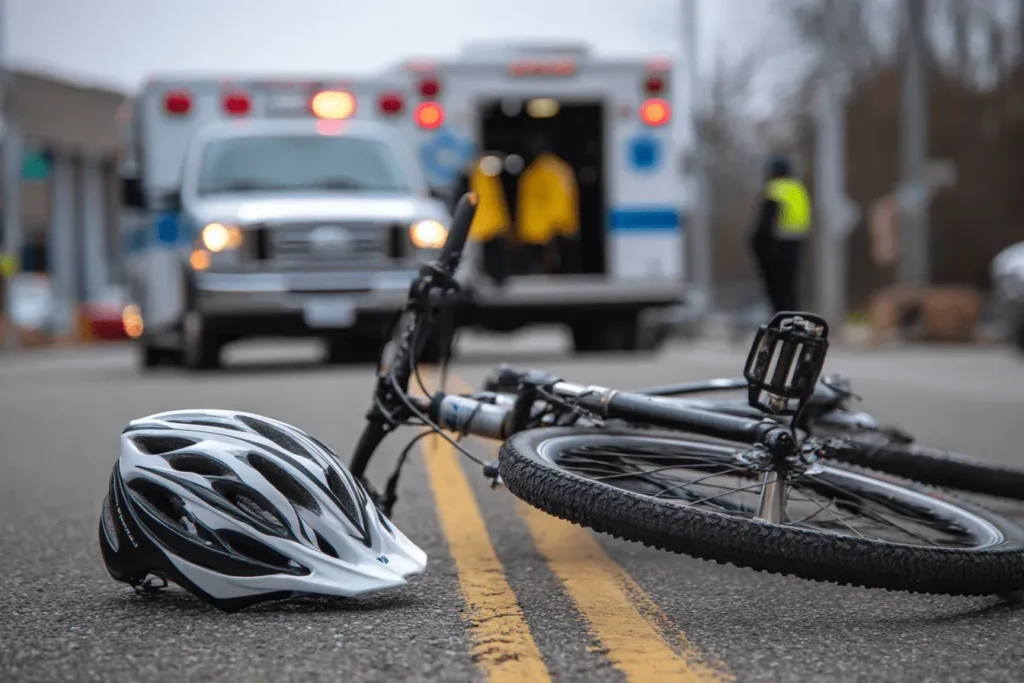
How to File a Bicycle Accident Claim in Boston Step by Step
Filing a bicycle accident claim in Boston means formally requesting compensation from an insurance company after a crash caused by someone else’s negligence. The process has six main steps, and the order matters.
- Open a PIP claim: Contact the at-fault driver’s insurer to start a Personal Injury Protection claim
- File the crash report: Submit the Massachusetts Crash Operator Report within five days
- Preserve evidence: Send a spoliation letter to prevent critical proof from being destroyed
- Notify your own insurer: Report the crash to your auto insurance company to protect your uninsured motorist coverage
- Document your losses: Track every medical bill, missed workday, and out-of-pocket expense
- Submit a demand package: Send a written summary of your injuries and requested compensation once treatment stabilizes
Each step builds on the last. Skipping one can reduce what you recover or eliminate your claim entirely.
What to Do Right after a Boston Bicycle Crash
The decisions you make in the first hour after a crash directly affect the strength of your claim. Even if you feel fine, you need to take specific steps before leaving the scene.
Call 911 immediately. A police report is one of the first things an insurance company will request, and it creates an official record of what happened. Stay until officers arrive and give your account of the crash.
While you wait, collect the following from the driver and any witnesses:
- The driver’s name, license number, and insurance policy information
- The vehicle’s license plate, make, and model
- Phone numbers and emails for every witness
Take photos of the entire scene, including the position of the vehicle, your bicycle, any skid marks, road conditions, and your visible injuries. Do not give a recorded statement to the driver’s insurance adjuster. Adjusters are trained to ask questions that reduce the value of your claim, and anything you say can be used against you later.
See a doctor within 24 hours even if the emergency room cleared you at the scene. Concussions and soft tissue injuries often do not show symptoms until the following day, and a gap in your medical records gives insurers a reason to question whether the crash caused your injuries.
Who Pays Your Medical Bills First
Massachusetts is a no-fault state. This means your medical bills are paid by a specific insurance policy first, regardless of who caused the crash. That coverage is called Personal Injury Protection, or PIP.
PIP pays the first $2,000 of your medical bills directly. After that, your health insurance takes over, and PIP picks up any remaining copays and uncovered costs up to the policy minimum of $8,000. This applies to cyclists because Massachusetts law extends PIP coverage to anyone hit by a motor vehicle, not just people inside cars.
PIP also covers 75 percent of your lost wages while you recover. If medical bills exceed $2,000 or your injury involves a fracture, permanent scarring, or significant loss of function, you can file a separate injury claim against the at-fault driver for pain, suffering, and the full value of your losses.
What Evidence Proves Your Claim
Insurance companies pay based on what you can prove. Strong evidence is the difference between a fair settlement and a lowball offer.
| Evidence Type | What It Proves |
| Police report and 911 audio | How the crash happened and who was at fault |
| Traffic and surveillance camera footage | Vehicle position, speed, and road conditions |
| Medical records and treatment timeline | The nature of your injuries and their connection to the crash |
| Damaged bike, helmet, and gear | The force of the impact and your replacement costs |
| Witness statements | An independent account of the driver’s actions |
Request your Boston Police report online or in person at the station. You can also request 911 audio through a public records request, which often captures the driver’s first account of events before they speak with their insurer.
Many Boston intersections have traffic cameras owned by the city or the MBTA, and nearby businesses often have exterior surveillance footage. This video is often deleted if it is not preserved promptly. We send preservation requests immediately so that footage is not lost before we can use it.
Do not throw away your damaged bicycle, helmet, or torn clothing. These items show the force of the crash and support your request for replacement costs.
What Compensation You Can Claim
Damages is the legal term for the money paid to compensate you after an injury. In a Boston bicycle accident claim, damages fall into two categories: economic and non-economic.
Economic damages cover your direct financial losses:
- Medical bills: Emergency care, surgery, hospital stays, physical therapy, and prescription costs
- Future care: The cost of any ongoing treatment your doctor expects you to need
- Lost wages: The income you missed while you were unable to work
- Earning capacity: Future income you cannot earn because the injury prevents you from returning to your job
Non-economic damages cover losses that do not come with a receipt:
- Pain and suffering: Compensation for the physical pain and emotional stress caused by the injury
- Scarring and disfigurement: Additional compensation for permanent, visible injuries
You can also claim smaller out-of-pocket costs like rideshare trips to medical appointments, copays, and the replacement value of your bicycle and gear.
How Massachusetts Law Affects Your Claim
Massachusetts has specific laws that shape how much you can recover and how long you have to act.
The three-year deadline: You have exactly three years from the date of the crash to file a lawsuit. Missing this deadline ends your claim permanently, even if the driver was clearly at fault.
The 51 percent rule: Massachusetts uses a comparative negligence system. This means you can recover compensation as long as you were less than 51 percent responsible for the crash. Your award is reduced by your share of fault. If a jury finds you 20 percent at fault and your total damages are $100,000, you would recover $80,000.
The four-foot passing law: Massachusetts requires drivers to give cyclists at least four feet of space when passing. The law also prohibits opening a car door into the path of a cyclist, and a driver who causes one of these dooring crashes has strong evidence of negligence working against them.
Government and MBTA claims: If your crash involved a city vehicle, a state vehicle, or was caused by a poorly maintained road, you must file a written notice called a presentment letter within two years. Damages against government entities are also capped by law, so these claims require immediate attention.
What to Do If the Driver Had No Insurance or Fled
Not every driver stops after a crash or carries adequate insurance. You still have options.
Uninsured motorist coverage, often called UM coverage, is a part of your own auto insurance policy that pays for your injuries when the at-fault driver has no insurance. Underinsured motorist coverage, or UIM, fills the gap when the driver’s policy limit is too small to cover your losses. Both apply even though you were on a bicycle.
If the driver fled the scene, report the crash to Boston Police immediately and notify your own insurer within 24 hours. Many policies require prompt reporting before they will release your UM coverage.
If the driver was working at the time of the crash, for example for a delivery service or rideshare company, there may be a commercial insurance policy available on top of the driver’s personal coverage. We identify all available insurance so you are not left with unpaid bills.
Do You Need a Boston Bicycle Accident Lawyer
You can file a basic claim on your own, but insurance companies are not on your side. Their goal is to pay as little as possible, and they have experienced adjusters working your case from day one.
We handle the insurance companies so you can focus on getting better. Specifically, we:
- Preserve evidence: We send spoliation letters and request camera footage before it disappears
- Handle all adjuster calls: We make sure nothing you say is used to reduce your claim
- Calculate the full value of your case: We work with medical and economic experts to account for future care and lost earning capacity
- Prepare for trial: We build every case as if it will go before a jury, which gives us stronger leverage at the negotiating table
There is no upfront cost to hire us. We work on a contingency fee, which means we only get paid if we recover compensation for you.
Contact Breakstone, White & Gluck Today
Breakstone, White & Gluck has spent more than 30 years fighting for Massachusetts injury victims. Every client works directly with one of our three founding partners, not a junior associate or a case manager. We have recovered significant settlements for injured cyclists.
We are also committed to bicycle safety in our community through Project KidSafe, providing helmets to children across Massachusetts.
Evidence disappears fast and legal deadlines do not move. Contact Breakstone, White & Gluck today for a free consultation. You pay nothing unless we win your case.
Boston Bicycle Accident Claim FAQs
Do I File a Claim with the Driver’s Insurer or My Own?
You file the Personal Injury Protection claim with the driver’s insurer first because Massachusetts no-fault law puts that coverage at the front of the line. You then notify your own insurer to protect your uninsured or underinsured motorist coverage in case you need it later.
How Long Does a Boston Bicycle Accident Claim Take to Settle?
Settlement timelines vary depending on the severity of your injuries and how cooperative the insurer is during negotiations. Cases that require litigation in court can take longer.
Do I Need a Police Report to File a Claim?
A police report is not legally required to file a claim, but insurers will almost always ask for one and it is one of the strongest pieces of evidence you can have. We always recommend calling 911 from the scene.
Does Not Wearing a Helmet Affect My Claim?
Massachusetts only requires helmets for riders under 16, so not wearing one does not prevent an adult from recovering compensation. Insurers sometimes try to use it to reduce a claim, and we push back firmly against that argument.
Can I File a Claim If I Was Riding Outside a Bike Lane?
Yes. Massachusetts law allows cyclists to use the full travel lane on most roads, and riding outside a designated bike lane does not eliminate your right to compensation when a driver’s negligence caused the crash.